
An ISO 9001:2015 Certified Company
Near Santhom School, Ankali, Sangli - 416410, Maharashtra, INDIA.

Creep Testing Machines

Home Creep Testing Machines

We are Manufacturer, Supplier, Exporter of Curved Beam with Bench & our setup is situated in Sangli, Maharashtra, India.

Datacone Engineers & Agro Processors offers high-quality Curved Beam Apparatus designed for practical training, experimentation, research, and educational applications in applied mechanics and mechanical engineering. The apparatus helps students, researchers, and engineering professionals understand the behavior of curved beams under different loading conditions, including stress distribution, deformation, bending moments and structural response. It is suitable for engineering colleges, universities, technical institutes and research laboratories.
Our Curved Beam Laboratory Equipment is designed to provide accurate and reliable practical demonstrations of important mechanics principles. The equipment enables students to study the behavior of curved beams and understand concepts related to bending stress, strain, load distribution and deformation through hands-on experiments. Manufactured with a focus on accuracy, durability, ease of operation and dependable performance our equipment is suitable for engineering education and laboratory research.
Datacone Engineers & Agro Processors also provides reliable Applied Mechanics Lab Equipment and Mechanics Laboratory Apparatus for academic practicals, student projects, technical training and research activities. Our Curved Beam Apparatus supports engineering institutions in developing practical knowledge of applied mechanics, structural behavior and mechanical analysis. With a focus on quality manufacturing, precision and reliable laboratory solutions, we serve customers across India looking for Curved Beam Laboratory Equipment, Applied Mechanics Lab Equipment and Mechanics Laboratory Apparatus.

HSN CODE : 9023 Model No : C-CTI-09
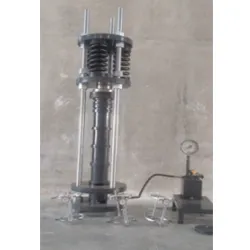
HSN CODE : 9023 Model No : RAC-014
TECHNICAL SPECIFICATIONS:
Technical Parameters:
  • Maximum Testing Force: 500KN
  • Measurement Range: 0–500KN
  • Relative Reading Error: ±1%
  • Spring Height: 300mm
  • Spring Compression Stroke: 52mm (or according to customer's requirement)
  • Distance Between Upper Platen and Lower Platen (Compression Space): 1500mm

The Equipment Consists of Following Parts:
  • Main frame suitable for 3 pieces of D150 × H300 mm concrete cylindrical samples.
  • Hand hydraulic pump (can replace with electric pump system at extra cost).
  • Hydraulic jack.
  • Stroke sensor.
  • Ball plate (with harden treatment) connecting between sensor and sample.
  • A self-contained bench mounting machine which demonstrates the phenomenon of creep under different conditions and in different materials.
  • Ideal for student use and classroom demonstrations.
  • Demonstrates the three phases of creep.
  • Demonstrates the effect of temperature on creep.
  • Compact and easily stored.
  • Supplied with weights and test specimens.
  • Inexpensive specimens readily available in lead and plastics.
  • Completely self-contained – needs no other parts.

Experiments:
  • The normal breaking load of a specimen over a fixed time.
  • Relationship between breaking load and time for lead specimens.
  • Time extension curves to show the three phases of creep (primary, secondary and tertiary).
  • The effect of temperature on the creep rate of specimens.
  • Creep recovery.
  • To comprise of a lever and weight machine with a long lever arm and a bearing as a pivot point.
  • The lever to have a mechanical advantage of 8:1.
  • A digital displacement indicator to measure the extension of the specimen.
  • A clear cylindrical enclosure to surround the specimen area to maintain a constant temperature.
  • Typical test times for lead specimens to be from 4 minutes to more than 18 hours at 200°C, depending upon the stress applied.

To Be Supplied With:
  • Laboratory standard thermometer and thermocouple to measure the temperature effects of creep.

Weight Range:
  • 1 × 100 g weight.
  • 2 × 200 g weights.
  • 3 × 500 g weights.
  • A cool pack to reduce specimen temperature.

Specimens:
  • 20 × BS1178 lead specimens.
  • Strain hardening coefficient: n =